
← All work

UX Research · Novo Nordisk · 2024

Navigating Complexity Through User Insight

During my time at Novo Nordisk, I took an active role in user testing sessions designed to refine UX processes and improve the overall experience through actionable insights — conducted as part of agile, iterative design sprints where hypotheses, concepts, and ideas were tested and refined to create real value for users.

Company & Industry
Novo Nordisk · Healthtech & Life Science
My Role
UX Researcher & Designer
Year
2024
Focus
User Testing · Iterative Design
Researcher conducting a user interview with clipboard

01, Context

Investigating, Testing, and Refining Solutions That Matter

Across my projects, I have gained hands-on experience in exploring, testing, and iterating digital health solutions in close collaboration with the people they are meant to support. Whether investigating how patients on Ozempic perceive and engage with their treatment journey, or examining how parents of children with Growth Hormone Syndrome and healthcare professionals interact with shared data, my work has focused on uncovering real needs, behaviours, and challenges.

Through interviews, user testing, and continuous iteration, I have developed concepts that not only mature through feedback but also align more closely with users' lived realities — ensuring that design decisions have a meaningful and positive impact on people's lives.

Due to the sensitivity of the data, I am unable to share specific examples, but the work reflects my ability to translate user insights into meaningful design improvements within a complex and regulated environment.

02, The Projects

Two studies, two user groups, one shared goal

Both projects followed the same iterative research process: define objectives, design a research guide, prototype, interview real users, synthesise insights, and repeat. Below are the two distinct studies I contributed to.

Patient interacting with a mobile health application

Project 01

Exploring User Perceptions of the Type 2 Diabetes Treatment Journey

  • Together with my team, I investigated user perceptions of a prototype that allowed Type 2 diabetes patients to track their treatment journey
  • We conducted eight user interviews in one week, using both in-person and online formats to capture diverse perspectives
  • We uncovered expectations and concerns, highlighting strengths and weaknesses in our solution
  • Feedback was integrated directly into the design process when developing new iterations of the concept
  • The goal: ensure that matured concepts were more intuitive and aligned with user needs, supporting clearer communication of complex medical information
Designer reviewing prototype wireframes and UX flows

Project 02

Testing a Two-Sided Prototype for Parents and Healthcare Professionals

  • We conducted a two-sided investigation of our prototype to understand usage across two distinct user groups:
    • The daily usage by parents of children with Growth Hormone Syndrome
    • How Healthcare Professionals engage with data provided by parents
  • The tests explored how an American user group interacted with the prototype, identifying needs, behaviours, and challenges on both sides
  • Over a two-week sprint, we developed five iterations — continuously integrating feedback to refine and test each version

03, Design Approach

My Iterative, User-Centred Design Approach

This model reflects my methodological approach to user involvement: designing with and for the people who will actually use the solution. By working iteratively — testing, gathering feedback, and refining prototypes — I ensure that design decisions are grounded in real user needs and continuously create value for end users.
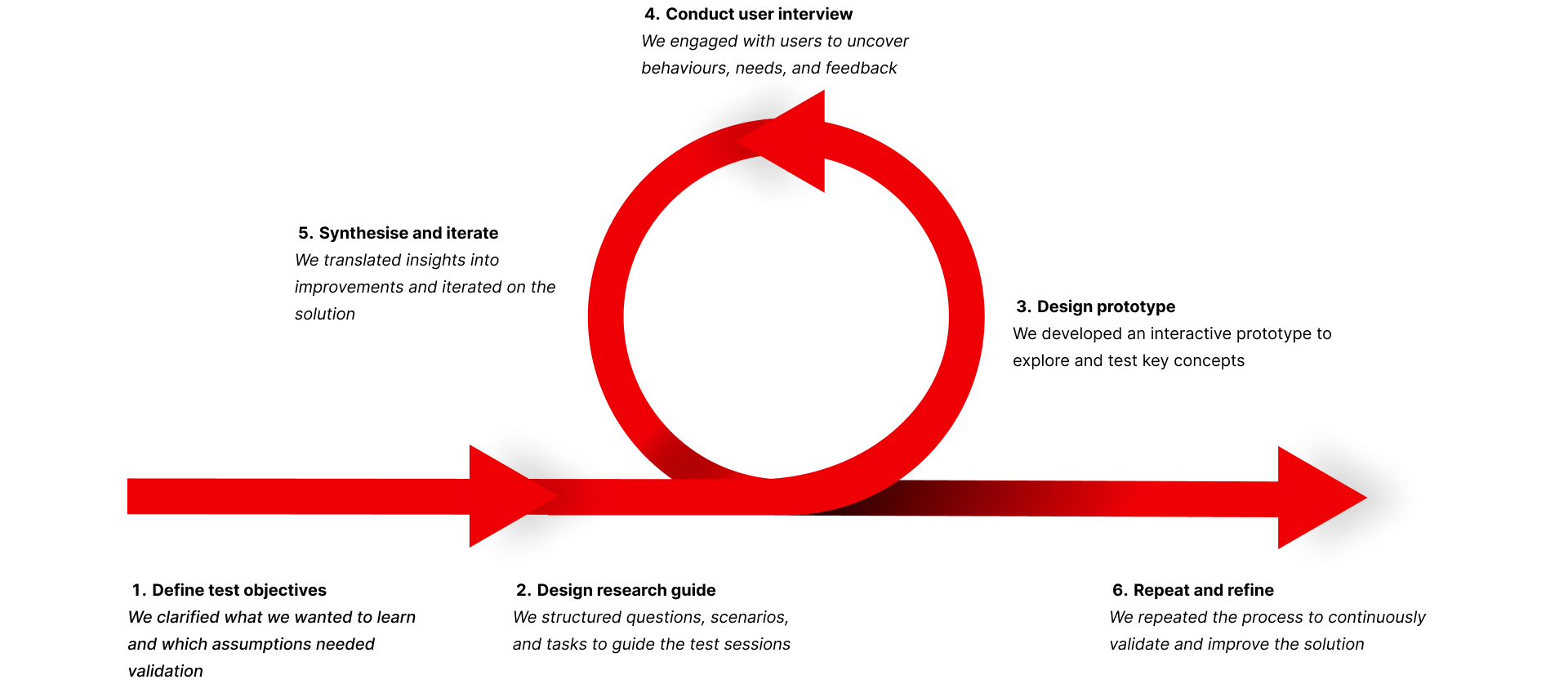
Iterative user-centred design process diagram showing six steps: Define test objectives, Design research guide, Design prototype, Conduct user interview, Synthesise and iterate, and Repeat and refine

Next Project

Commercialization of B2B Platform →